Showing posts with label portable. Show all posts

2026-04-29

First QSO(s) on a New Band: 5.7GHz.

Yesterday evening I went a bit up-hill to make experiments on 2.4,  5.7 and 10GHz.

The place is only 2km from my home, and with aspace to park and set up a portable station.

I was bringing my IC-905 with the 10GHz unit added, and three antennas:

For 2m-70cm-23cm a vertical with a magnetic mount for the car

For 2.4GHz a tiny panel antenna (Hybrid double quad) (10dBi?)

For 5.7GHz a tall and narrow panel antenna, about 18dBi gain

For 10GHz a 22dBi horn antenna.

Modest station, loosely mounted on a  mobile camera support.

I have made tests earlier on 2.4GHz, from a hill with no car access a bit furthe away, and from the place of yesterday.

The first test on 2.4 GHz didn't go well, as I had the antenna mounted with vertical polarisation, and the others were using horizontal. that can happen when you don't look carefully at the cable coming out from the feed point. The antenna was a yagi mounted inside a pipe "radome", so it couldn't be seen as such. Yess, silly me....

Second test was quite sucessful, with solid signals locally, at distances of about 25km, even using FM.

Yesterday's test started poorly, because the vertical on the car was absolutely not working. SWR infinite...

Looks like a bad connector, I will have to check, because it's a useful backup coom.. So no way of discussing the experiments on air.

So a phone call to OZ1GIN, working with indoor antennas on microwaves. Things did work well enough from the nearby hill, (essentially line of sight) so it was interesting to see how the system worked from a less ideal site.

Fist experiment: Test on 10GHz. I could hear the local beacon hidden behind a hill, so my system was certainly working. He could also hear the beacon with the indoor antenna. Trying to point the antennas we took turns with transmitting "beacon" signals and adjust antennas. 

No signals detected from either side. 10GHZ wasn't working.

On 2.4 GHz I was using a considerable smaller antenna than the first test. Signals were weak, but a QSO in CW could be made.

The 2.4GHz system was also less, as in the previous tests the cable was connected directly to the "base" RF unit, and yesterday the 2.4GHz signals went through the 10GHz unit.

There is definitely room for improvement. 

Then OZ4HZ (as agreed) made a test. A QSO with SSB was possible, although with weak signals.

2.4GHz with the smaller antenna was a qualified succes. 

On 5.7GHz OZ1GIN started in the same way as on 10GHz, with sending beacon signals and turning the antennas. After a few tries, where we also needed adjusting frequency a bit, we managed to make a CW QSO, with slightly better signals than on 2.4GHz.

The signals from OZ1GIN had some scatter sound, warbling a bit, I had not expected it on the distance of 25km, but hinking about it, I probably should. There was also some moderate fading.

Then OZ4HZ, working from an apartment block came with SSB, and we could also work a bit better than on 2,4GHz. His signals did not have scatter sound, so the path was probably closer to line-of-sight than OZ1GIN.

This was my first and second QSO on 5.7GHz.

Now it's time to improve the setup, mechanically and electrically. I am fully aware that there is a lot of room for improvements. 

I should also think of getting some setup at home for those frequencies. Limited height and terrain, including neigbour's houses and some trees will put quite some limits on that, but it should be possible to male some occasional contacts, for example via rain scatter on 10GHz. I have some experiments in mind, probably more on that later.

2025-07-20

QSOs on a New Band. 2400MHz.

 A few days ago I got a mail, someone was planning to do activity from the island of Moen. A distance of about 77km from me.

The operation was planned for this afternoon, and they would acttivate both 1296 and 2400MHz.

I went out about 2km from home and set up the IC905 with small antennas for the 2 bands.

I think they stopped activity about the ime I got set up, so I called some of the locals who had 2400MHz capability.I was not on the hilltop as the earlier tests, so it's always interestingt to see how a new band works. I called OZ4HZ, who had a station with antenna on a balcony. Signals on 1296 were booming in, so we decided to test 2400. Signals from Hans were weak, but readable, and we made a marginal QSO in SSB, exchanging callsigns and reports both ways, 52-53 reports. Not bad for a first test on the band.

I had texted OZ1GIN and told him about the activity, and h came on after a while. Also with booming signals on 23cm. The test on 2300MHz had weak, but easily readable signals in CW. We exchanged 559 reports at 25km distance. This is a special case as Allan was running with a completely indoor system, including the antennas.

After the experiments I started listening for beacons on 1296, and heard 2 in SM6, at least one in LA, and also OZ5SHF at Yding, one of the highest points in OZ, and the whole time, most of the time booning in, and audibl with the antenna in all directions. There was most certainly tropo today. It's now about 2200 local time, and with my vertical at home it's still coming in with  solid copy, even at the other end of th4e house.

There is still a lot to optimize in the portable microwave system, so maybe better results next time.

Right now I am not complaining.

2025-06-19

NAC, Tuesday 17th June.

 After last month's adventure I made the trip to the local hill to do some more 1296MHz activity.

The hill is 80m (250ft)high and has an unobstructed view for a few 10s of km.

As before, I was running 10W SSB/FM/CW and a 12 element Yagi antenna. Not a big setup, 

Everything was transported from the parking place to the top, distance to walk, about 400-500m, and steep uphill, bit I can do it alone if necessary.

If the weather behaves well, I might also go up there on a Friday evening where we have a weekly FM-simplex net on 433, 50, 70, 145MHz and 1296MHz was recently added. 10W with a good view should be quite good, especially on 1296. 

I was a bit late in getting ready, so I arrived and was ready to operate about 20 minutes after the test started, and immediately there was a QSO with extremely strong signals from another hill about 25km away. Both hills about 8m ASL, so line-of sight.

I worked the highest number of stations in this test, that I have ever done on 23cm. 

The best distance was SM6UTZ at 307km distance, and a few others were above 100km, so I have no complaints.

My antenna was, as usual, mounted horizontally, and I also worked a Copenhagen station OZ13JK, working with a 3-band vertical, I think about 2-3m above ground. That was an improvement over the test last year, when he was trying, and just making a QSO with a handheld 23cm radio and a small handheld yagi antenna.

I tested the sewtup, listening to beacons, 2 of the LA beacons were heard at about 400km, two Swedish beacons not far from Gothenburg, and the Polish SR1KOL at 370km was heard all evening.

I think there was a bit of a tropo lift, as some signals got stronger later in the evening.This was a good outing, and I expect to try it again when the weather allows.

2025-06-09

Portable Work on 1296MHz, Tuesday NAC.

 With a bit of preparation, we went to JO65FH on the Peninsula of Stevns to operate a bit in the 1296MHz Nordic Activity Contest.(NAC).

I had arranged with Jorgen, OZ7TA to go there with our equipment and test out the suitability of the site.

This is the site for an old cold war radar station with a magnificent view over parts of the Baltic, so we had antennas about 42-45m above sea level with good flat land for over distances up to 20km.

I had brought my IC-905 and Jorgen his Langstone project transceiver with a 1296MHz "front end" , i.e. TX power amplifier, RX preamplifier and filter. The Langstone is based on a Pluto SDR and Raspbeery Pi 4 with the appropriate software, and will work from 70MHz to 6GHz - with different "front ends"

I brought the 10GHz transverter for the '905 and a 22dBi horn antenna to make a test of the system. unfortunately the SMA connector broke after setting up the system, so the 10GHz testing was cancelled.

On 23cm we both had extremely strong radar signals. So strong that we suspected breakthrough from a nearby radar. Later we found that many other stations had the same problem, so this was very strong propagation.

We made a few contacts, mostly with very strong stations, the weaker signals were drowning in the radar signals.

One drawback that I had not expected was the connection with the ON4KST chat. Because we had a view over the water to Sweden, the 5G connection switched between OZ and SM, so the connection was broken, almost every time I checked it.

That is how it goes. Every time we go out in the field, there is something new to learn, so let's see if we can do better next time.

2024-05-22

NAC 1296 May From a Hilltop.

Tuesday evening we had the 1296MHz segment of the Nordic Activity Contest.

I decided to go to a nearby hilltop at 80m ASL. It is in the same locator (JO65CP) as my home, so it's a short drive, and a walk of about 500m with a climb of about 40m at the steep part the slope is about 20 deg.

Due to the walk I only brought the basic gear fitting into a rucksack:

- the IC-905 control unit with the microphone and the RF unit, and of course interconnection cables

- a 12 element yagi with a few metres of cable

- 2 tripods, for the control unit and the antenna, fitting at the sides of the rucksack.

- a 12V 20Ah LiPO4 battery.

- a small log-periodic

- a paper logbook (computer is too bulky and adds weight)

This fills the rucksack up and is still fairly easy to carry on the back.

Additionally a very light weight support (without backrest), so I could sit a bit while operating.

The walk from the parking took me about 20-25 minutes, and the setting up another 10-15 minutes, so I was ready about 10 minutes before the test started. Time to test reception of the 2400MHz and 5760MHz. The test was done with the tiny log periodic PCB based antenna, and both beacons came in with good signals, even with the antenna less than half a meter above ground, and with some attenuation from trees.

This is a pretty good place to do some microwave activities, despite some bushes shading the signals in some directions.

Time to listen on 1296 before the test.

Beacons coming through: OZ7IGY (of course it is less than 25km away), OZ5SHF at another hill 155km away, OZ1UHF at 220km, SK6UHI at 261km, the DB0VC in Kiel at 185km, and finally LA1UHG at 394km. Not bad for a small 12 element yagi antenna and a non modified radio. The setup is working.

Tarting the test I was listening to OZ7TA at about 40km, also at about 80m ASL. Not surprising the signal was booming in, as there is line-of-sight. He had some trouble with his setup, so I missed the QSO.

A total of 9 QSOs were made, not too bad for a first outing. The best distances were OZ3Z at 157km and SM6CEN at 195km.

OZ1LXL at about 40km was shocked, my signal was the strongest he had heard on 1296, and we had a comfortable QSO using FM.

Lessons learned:

Lesson #1: I need to bring a CW key(er). Several stations were calling CQ in CW, and I missed them If I just wanted to call and make a standard QSO I could have done it with pre-programmed texts in the built-in keyer, but I had not done that. If I wanted to male fully random QSOs, calling CQ myself, I could do the CQs with the pre-programmed texts, but I still need the keyer to send the call of the caller. Good lesson: make some pre-programmed texts, and bring a simple key(er) for CW.

Lesson #2: I need to bring a handheld for 2m and 70cm. Some locals would like to coordinate, and know that I was on 1296 from a hilltop.

Lesson #3: I should switch the tripods. The antenna could only be raised to less than 1.5m above ground, and it should go a bit higher.

Lesson #4: I could use a smaller battery. the current battery is quite bulky, filling up a good part of the rucksack, and could go for many hours (more than I needed for this operation). This might give some space for the 10GHz module for another outing with the IC-905.

I did have a good day (evening) at the first operation from the local hilltop, and I think I will try it again, with improvements of the setup.

If you have any other ideas for improving the "real portable" outing, please feel free to suggest them in comments.

Edit:

I found that it is possible to use some of the microphone buttons as a keyer paddle. Good to know another time. I think I could have made a few more QSOs that way. Yes, learning is a good part of this.


2024-04-07

1296MHz etc. Portable. New Toy.

 I have got myself a new transceiver. For the microwave band I am now testing a new IC-905 and the 10GHz module (transverter).

This rig runs 10W on 144,432 and 1296MHz, and 2W on 2.4GHz and 5.7GHz, and 500mW on 10GHz.

It has 2 mast mounted modules, one transceiver for 144,432,1296MHz, 2.4GHz and 5.7GHz, the other converts the 2400MHz band to 10GHz. Everything is controlled fro a control module that resembles the IC-705, and it feeds 40V up to the modules via PoE (Power over Ethernet), and the rig has a common N-connector for 144,432 and 1296MHz, and separate SMA connectors for each of the higher bands.

The system has a built-in GPS for controlling the reference frequencies.

Time to do some tests, I started a few days ago. First, get it up on a tripod in the living room, and the tests could begin.

The very first tests was checking that the GPS system worked, and even indoors it would lock. I should be right on the frequency in the display.

I have not yet tested the 144 and 432MHz parts, but I set up a small 12 elements yagi in my living room, just 0.5m (about 2 feet) above the floor. To my surprise the OZ7IGY beacon located behind some hills about 20m higher was clearly audible. First successful test done!

I tried setting up a 2400MHz yagi (16 elements), and I was not surprised that I heard nothing from OZ7IGY. I could hear noises that I suspect came from the local wireless network. 

Using a PCB log-periodic antenna, exactly the same happened on 5760MHz. 

On 10GHz I set up a synthesizer generator in the house, and got a strong signal, using a PCB patch antenna array (16 patches in a 4x4 array). The transmit side was tested using my QO-100 receive setup, and worked nicely.

Today it was time to get out in the field. Temperature in the 15-20C range and some sunshine, it was a beautiful day to get started. I drove the system a few km from my home, just a bit up a hill, but not to the top (no driving permitted there). It took about 1/2 hour to get it up, and the test could begin, using the exact same antennas as in the indoor test.

The 1296MHz antenna was about 2.5m above ground and turned towards OZ7IGY. Signal was booming in, above S9. RX Success!

The 2400MHz antenna was very low above ground, about 70cm. The signal from OZ7IGY was a solid copy, though not very strong. RX Success

On 5760MHz the beacon was all but inaudible. I thought I could hear a signal tuning around the frequency, but I was not 100% sure, so I say no reception.

On 10GHz no reception (not surprising).

On 5.7 and 10GHz the cables used were some surplus semi-rigid cables with angled SMA connectors, so I suspect high losses, but the test had to be made. I am sure I could have gone to a different location with no hills in the way, and get reception, but I stayed because there was one more test to do.

I called on the local FM frequency (1297.500), and as I had announced my activity locally, there was immediate calls from 2 stations in the Copenhagen area and one in Sweden, just across the water. The SM7 station was 43km away and a solid S9, with a fairly unobstructed path.

One of the locals alerted a station in the other direction where there are some obstructing hills. Call made and good signals at 43km in the more obstructed path.

This was "first light" for my IC-905, and I am satisfied with the results. I can see many possible improvements to the system, so I have quite some work to do with the mechanical part of the portable system. Mainly better antennas for 2.4, 5.7 and 10GHz, and a better way to fix those antennas to the tripod. 

At today's test the 1.3 and 2.4GHz yagi antennas were mounted using gaffer tape, so there is already some hardware that I will need to go get, some holes to be drilled, so I can mount those antennas to the mast in a more secure way. As a first test, it was good enough, though.

2023-02-19

Assembling a Portable Station for 23cm FM.

As indicated earlier I am beginning to make my station operational on 23cm.

As it will take some better weather (and temperatures) to get the home station up and running, I am focusing on making an operational portable station.

Looking through the house I found the following equipment and antennas, all for 23cm in general:

- The Standard C701 hand held with 300mW out on 1296MHz FM

- The X5000 antenna (1.8m long) used at the first successful experiment in the garden last week end

- A 12 element yagi, mounted on the camera tripod

- The assembled 16 element yagi from Flexa is intended for home use

- I also located a smaller triband vertical antenna, mainly for fixed use

- There was one more antenna suitable for mobile use. A 3-band 1m long antenna and a magnetic mount

- I found an older TM741 FM transceiver with a 23cm module. It needs testing, and if it is in working order I can use that with a 12V (13.8V) battery out there, providing 10W if I operate (stationary) from the vehicle. Much better than just 300mW, but less practical on a hilltop where I have to carry all the stuff up there

- I do have a 12V 50Ah battery that can be brought in the vehicle. Not practical to carry to the hilltop.

- Somewhere I should have the X7000 antenna (5m long) If I can find it I should probably mount it at home with a short mast, just to get started from home. Mounted low it will likely just be suitable for very local contacts, but it can be a start

- I should have an old transverter that could possibly be used for portable use with a 2m transceiver. I need to find it and test it

Back to the portable station which (initially) has better chances of successful contacts.

I am assembling the following to bring out to check some places around here:

A. Very lightweight:

1) The handheld C701. It will be of limited use due to the low output power, but is very portable.

2) The 12 element yagi as a horizontal antenna on the camera tripod is very light and can be carried up a steep path to a hilltop.

3) I may bring the short vertical to the hilltop with a lightweight fiberglass mast.

4) If I can find or build a small lightweight power amplifier, maybe with a preamplifier that could complete a very lightweight 23cm FM portable station with a bit better range. This will require a relatively lightweight 12V battery. The 50Ah one is too heavy to carry.

B. Using the vehicle - not lightweight:

1) The TM741 FM transceiver (when checked)

2) The mobile 3-band whip with the magnetic mount for vertical polarization

3) The 12 element yagi for horizontal polarization, and with more gain than the magmount/veertical

4) The 12V 50Ah battery

With regard to option B I have a somewhat suitable location not too far away, with a good view in the direction of Copenhagen.

Now we wait for some decent weather and some willing and able participants to the tests. Timing is of essence ;)

2023-02-15

Portable Antenna for 23cm.

 I located the old 12 element Yagi antenna I had lying around and made it ready for some portable operation on the band.

I found an old photo tripod that had lost the mounting plate and used the simplest possible method of attaching the antenna: Duct tape. Yes laugh away, but it is good enough for a few tests I want to do, but of course a better mounting is needed for more stability of the setup.

As thing are now, I can go out on a hilltop (or other place with a good view) and operate 23cm FM at horizontal polarization, but just 300mW from the handheld transceiver. This can be carried easily on to a hilltop, also with a few spare batteries, and a few experiments can be done.

I do have a mobile transceiver, the TM741 with a 23cm module. I need to test that and if it is still in good working order I will have 10W output.. This can be easily used from the car, with a 12V battery. The 12V battery of the EV is not suitable, so a better battery is needed. This I cannot carry around easily, so hilltops not accessible by vehicles are not in my thoughts unless there will be two people carrying the equipment.

The old transverter I have also needs to be tested, and if it is in good working order, 5-10W SSB/CW operation. As IF transceiver I can use my old IC202 or the FT817. Both need a modification to control the transverter.

For home operation there is much more work to do, as nI will need a good vertical setup and the 16 element yagi on a rotator, too. hat will take a bit longer.

My crystal ball shows a bit of 23cm activity in my future ;) .

2022-05-10

Microwave Day.

 In the past week end I went to the Microwave Day in the town of Horsens, Denmark.

Although I have not really built any microwave equipment yet, everyone interested is welcome, and I did also go to the previous one 3 years ago - the ones in the last two years were canceled due to the COVID situation.

I wanted to take things easy, so I did the drive there on Friday, and home again on Sunday.

There were two presentations, one about the Norwegian beacon LB2SHF and the other about the 122GHz experiments. 

After the presentations there was social gathering and microwave talk, as well as Ole, OZ2OE demonstrating his 122GHz equipment. 

There was a small flea market, and I got just a few things. Two N-connector to WR90 waveguide transitions and some ancient 12GHz LNBs with WR75 waveguide inputs.

Because I have some horn antennas for both sizes of waveguide I wanted to have this. The WR90 transitions can be used as they are, and the LNBs can be used in different ways:

1) As a simple down converter, used as-is.

2) As an "active antenna". This requires a modification, taking the output of the 10-12GHz (pre)amplifier to an SMA connector.

3) Removing all the electronics and grinding a bit of material away, the LNB can also be used as a waveguide to SMA transition.

At the flea market I also saw transverters. There was an old version of the DB6NT transverter, complete with a horn antenna for a reasonable price, even if the output power was limited to 30mW. I did not bring it home, but I should probably have bought it, as I do have another 10GHz amplifier module that could have increased the output to about 200mW. A bit of a regret, but there may be other opportunities.

A 24GHz transverter, also at a reasonable price, was seen, but again, I did not bring it home. I know the seller, however, so I could probably still find it for sale.

Then there is test equipment. I had an appointment with another participant, that he would bring a 26GHz spectrum analyzer to check and possibly buy, and I did bring it home. I can now see what the things I build and buy are doing, signal-wise.

In the afternoon there was a demonstration of the 122GHz equipment at a longer distance (5km). Not that far, but not so easy. Signals were heard both ways, though.

Some time ago I purchased a CBNL 10GHz link transceiver module, but there is not much information, so I asked if any of the others had more information.

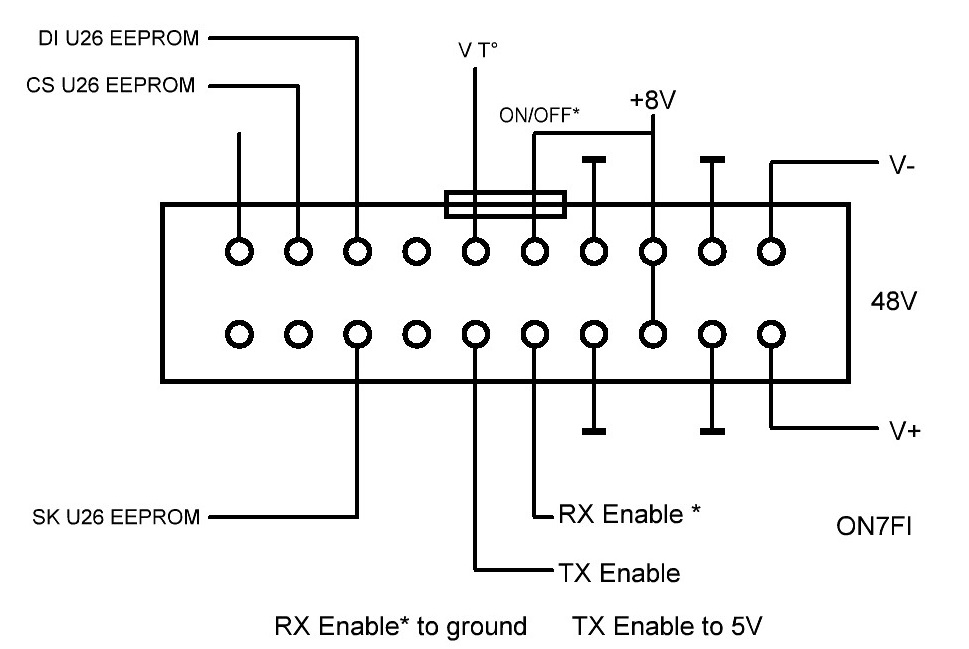
I have found a bit, but I am worried about the simple stuff: How critical is the order in which I connect the power supply. On the on6ll.be website I found the following:

Since it is used in a remote link the "base supply voltage is 48V (see the two connections at the right side of the connector). Then I see that there is a +8V connection The question is now - do I connect the 48V first, or the 8V? What I cannot easily see is where the negative bias for the GaAsFETs is generated. From the 48V converted to 7V, or from the 8V? It is not even clear if the 8V is generated on board when the 48V is connected. 

The other parts I have found sufficient information about to proceed. The LO should be somewhere around 7.5-8GHz, and the IF for the "RF/microwave" section then uses an IF of about 2.4GHz.

The T/R switching is clear enough from the description on the website, even the illustration above.

If any reader knows I would appreciate the information. I simply do not want to make a potentially destructive test, as the GaAsFETs simply will self destruct if the drain voltage is applied before the negative gate bias, as those familiar with GaAsFETs will know. If no reader knows I will have to extend the search.

Good to be back doing social activities again, there will be a few more coming up in the next months. Some of them will be outdoors, and others indoors. The next one is only a few weeks away.

2020-08-27

A More Expensive, But Not That Expensive, Portable Receiver.

On Ebay I purchased the Tecsun PL-660 portable radio receiver.

The PL-660 covers long wave (LW), medium wave (MW, AM band),  short wave (SW) up to 30MHz, the FM broadcast band (76 - 108MHz)  and the 118 - 136MHz air band (using AM). The receiver is also capable of AM synchronous demodulation and SSB  reception.

The receiver has a digital signal processing demodulator at the IF, and provides two bandwidths on AM reception, and that is a very useful feature, I found.

The receiver has an antenna input jack, specified to work on SW and the FM band. A test shows that it sooks like working in the air band as well. An external (active) antenna for air band reception should provide useful,  an FM antenna should be interesting, too.

The receiver uses 4 AA size cells for it power supply. These can be 1.5V (alkaline) or 1.2V rechargeable cells. I used a set of Eneloop (NiMH) cells, and when fully charged, they showed "battery full" on the indicator, and also tells that I was using NiMH batteries. It stayed like that throughout the testing of the radio.


The air band would have been perfect for my propagation monitoring if the VOR band 108 - 188MHz were included, but I reckon that I could use a low cost SDR for that, if need be.

A quick test showed that the sensitivity of the receiver is quite good on MW,SW and FM, as well as the lower part of the air band. The higher part of the air band seemed to lack gain, maybe due to bad tracking of the input filter.

Speaker quality sounds quite good for its size.

To me, however, it sounds like the DSP (demodulator/IF filter) could be improved, I detected some distortion, especially with somewhat noisy signals, that I never noticed on a fully analog receiver, or with my Icom IC-7300 and similar SDR/DSP heavy radios. OK, I guess that I got what I payed for ;)

I do think that this could be improved in later models. I suspect that it is not possible, or at least not easy, to update the firmware of the PL-660.

The accompanying power adapter, however was a bit of a disappointment. The adapter from US plug to EU plug did not fit into a mains socket, and just bent completely out of shape, no matter how carefully I tried to insert the plug(adapter). So I could simply not test the power adapter. I should probably try to find a suitable adapter, or simply cut the cord with the plug for the radio and make my own 6V power supply for this receiver.

All in all it is a nice and usable addition to my receiver park, I like monitoring a lot of frequencies simultaneously, to get an idea of the radio propagation conditions, be it on LW,MW,SW or VHF/UHF/Microwaves. The previously purchased "cheap" receiver is no more than just a toy, unlike this one. 

Maybe I should make another post or a few, about the setup I use for propagation monitoring. I think, however, that this should be at a later stage when I have completed more of the system.


2019-05-31

Vaguely 10GHz Related: Leaking Alkaline Batteries.

How is leaking alkaline batteries in any way related to 10GHz?, you may ask.

Here goes :

For my wideband 10GHz experiments I need a portable receiver. For the initial experiments I plan to use a portable scanner capable of receiving the IF from a LNB, and it needs to be wideband FM capable.
My old AOR AR-8200 is such a beast, and it has been lying with old batteries for a while, so the battery casing was full of leaked potassium hydroxide - nasty stuff. What to do? Of course, googling a bit does help, and I found that using vinegar should neutralize and make the residue removable, so I tried. Indeed, that helped, but vinegar is somewhat acidic, so in order to avoid further corrosion it has to be washed. The idea is to start with isopropyl-alcohol, then demineralized water, and then let it dry.

I did test that the radio worked with an external power supply, and it is alive, indeed. The best thing about the AR-8200 is that it also receives SSB, so tests can be made with narrow band reception in the field, too.

Next:
I have an old ICOM R3, only AM-FM-WFM capable with a totally dead battery pack. That one has a different power connector to the other radios I have - and runs on 6V only, so I have not yet tested if it is alive.
I hope so, because then I can set up two receivers on 10GHz, and make a WBFM transmitter or two, testing the range of the HB100 module, and possibly make a two-way QSO on 10GHz with those.

You may say that I could "just" use a standard FM receiver, but that requires a second converter after the LNB, and I want to start the simplest possible way. The other way would be using the HB100 module as down converter, but then the sensitivity will suffer in a significant way, probably about 20 dB worse, maybe more, than the LNB system, thereby reducing the possible range, by a lot.

Well, in any case, with a set-up of a single modulated HB100 transmitter and the LNB receive system, I can, at least, test the range of the HB100 module as it is.

Well here is to getting the AR-8200 cleaned and ready for action, and getting a modulator made for the HB100.