Showing posts with label Test equipment. Show all posts

2026-03-03

Tidying and Birthday Present.

 As the house is a total mess, a massive task of tidying has been started. It will likely last the whole year, or longer. 

The first task was getting down to the surface of the work desk, test bench.

I found most of the test bench surface ;).

Then I had my birthday recently, and I decided to get myself a present.

I have started doing a bit of microwave activity, and I got myself a TinySA a while ago. This measures up to about 6GHz and has a generator for the same frequency range.

It looks like the generator can show harmonic output well over the 10GHz range. Interesting.

So I decided that I should be able to check filters and amplifiers up to the 6GHz range, and purchased the corresponding NanoVNA, got it calibrated with the calibration set that came with the VNA. 

I have created a few presets, and saved them into the VNA:

350 - 550MHz

2 - 3 GHz and 

5 - 6GHz. 

There is space fro a few more, so I will likely add a range for the 3.4GHz band, the 1296MHz band and maybe one other.

The initial test today showed pretty realistic results, so I consider it a success.

Now I can do a bit of experimentation again. There is a plethora of small and big projects for all frequencies, from 472kHz up to 10GHz, at least. The experimentation may be slow, but it's possible.


2023-12-01

Tidy, Or Untidy? That Is the Question.

 My house has grown very intidy the past few years, after having had to do chemo therapy and an operation, then starting to recover, then the COVID-19 pandemic started, I have not had too much energy to do both, some radio activity and getting more tidy.

Well the radio activity is an ongoing thing, has been for 50 years now, so I am not planning to stop that.

But now I got started with a process that will take months, possibly years, or is it another ongoing process? Yes getting the house more tidy, and getting a few things working again, in the house.

Today I finally got two middle-age computers disassembled: An old Pentium 2 and another oldie, a Pentium 3. Those were "compact" Compaq's, so they took time and not so common tools (especially screwdrivers) to take apart.

I will only recycle very few things for my own recycling, everything else goes to the "official recycling".

- the top and bottom covers can be used as "chassis" for some projects, or as a support for a mag-mount antenna.

From the PC boards very little is useable. Some toroids can be used for EMC means, and there are some SMD inductors, too. Other parts, yes, maybe some power supply ICs and crystal oscillators, possibly a few of the connectors. That is all. The rest goes to "official" recycling.

There is more ancient computer stuff, and most of that will be treated the same way.

Then there is some stone age test equipment for my radio like:

- a 10-500MHz synthesized signal generator

- ancient Marconi signal generator, so old that it uses a classical free running oscillator.

- a signal generator for 1.7-4.4GHz. Real stone age, built with a klystron (tube/valve) oscillator.

For those heavy pieces there will be a bit to salvage. I suspect that I can easily salvage the step- and variable attenuators. Attenuators are always useful. Some cables, connectors, knobs etc, then decide what more useful material can be found in there.

Yes it will make for a busy time, but it will provide me with more space to do radio, and other activities.

2023-05-21

Rally in a Local Club. Got Some Stuff.

Yesterday I went to a local rally/flea market.

I made one relatively large purchase, a microwave frequency counter, the Anritsu MF76A specified up to 18GHZ.

This is a very nice piece of equipment, and looks well calibrated. The 10MHz reference oscillator is about 0.7Hz off from my 10MHz GPS reference output, after a warm-up of 1/2 to 1 hour. 

There seems to be one fault. When I switch the 10MHz connector to reference input, the counter seems to simply stop. No lights at all. As I would like to use the counter with the best possible reference (GPF locked) This needs to be corrected.

As an intermediate solution (the counter is otherwise fully functional) I can attempt a fine calibration of the internal reference oscillator. If I can bring it within 100-200mHz on 10MHz (after warm up) that is a quite acceptable accuracy.

I will contact the seller to see if he has more information than I could find in an internet search. My searching for about an hour did not even yield a user manual. The seller (a local radio amateur) has already indicated that I should contact him in case of any trouble, and I will do that.

But as the counter stands I can measure 10GHz signals with an accuracy of less than 1kHz, which is quite acceptable for daily use.

The second thing I brought home was a swap. I had two Rubidium 10MHz standard modules, and the first thing I got out of this swap was an old 2m multimode transceiver, the FT-290R. I was particularly looking for the original (mk 1) model, as the Mk 2 model has a "feature" that would drive me crazy. When switching  from CW to SSB, or from SSB to CW the mode would rotate via the FM mode and jump from the original frequency to the nearest FM channel frequency - and STAY there. That is simply not workable for SSB/CW work.

This looked in good condition, the only thing needed is a microphone.

A quick test of the FT-290R showed a functional transceiver with a signal of -135dBm easily heard in the SSB/CW mode, and about 2.5W output, as specified.

This transceiver, as it is, will be usable for controlling some microwave transverters, such as the Kuhne/DB6NT ones, via the VHF control cable, as there is a 7V DC signal at the antenna port when in transmit mode.

In the swap there was also an old AM/SSB CB transceiver. It came without cover, but as I intend to convert it into a 10m SSB/AM (CW?) transceiver it does not matter too much, as it will likely be heavily modified and mounted in another casing. This is a project for much later, but it is good to have some decent raw material. Yes, I need to make a rough test of this radio, that is also for later.

All in all a good day, meeting a lot of old friends and some new hams. There was an exam at the event, and 10 people passed, among them a young man of 13 who passed the exam for the highest class license.

2023-01-10

Mini Project #1.

Before the NanoVNAs became widely available it was tricky to find low cost test equipment for testing SWR or return loss in the low GHz range. 

At the time I did find one possibility: The transverter-store in Ukraine sold some low cost impedance bridge PCBs, so I got myself one.

The PCB bridge circuitry looks like this:


Looking at a Youtube video I found that the PCB has a fault. The bridge has 2 50Ohm resistances, made up by two 50Ohm resistors that should be connected in parallel. On the PCB he tested, and on mine, this is not the case. No connection between 2x two islands on one side of each pair.

Now, this is not difficult to correct. A short piece of wire  mounted at the junctions between the resistor pairs solve this.


A quick test using my NanoVNA 2 showed a shortcoming of the NanoVNA output level (too low), but also gave an indication of the functioning of the bridge.

With a 6dB attenuator as the DUT (Device Under Test) the return loss showed close to 12dB, as it should.

Testing a 10dB attenuator the same way showed that the return loss went down into the noise of the NanoVNA. Close enough to 20dB, so I accept the reading as correct, and that the bridge is working properly.

That is the end of mini project #1 of this year.

Will I use this bridge a lot? Not really, but I did want it to be in working order. It is now going into the test PCB pile as a working unit.

The NanoVNAs that came out after this are much easier yo use, and much more versatile. The cost is not prohibitive, so in the lab I will be using a NanoVNA F (I think is the designation) for frequencies up to 1GHz, and a NanoVNA v2 for up to 4GHz.

2022-06-12

Es on 10m, 6m and 4m.

 The sporadic E season seemed to start a bit slow this year.

OK, I was away for a week around 3. June, so I have probably missed several openings.

Now I am back, and the activity has got going again.

In my 5W challenge I have worked a few dozen QSOs on 10 and 6m. The QSOs worked in the challenge just passed 200, so I am fully on track. On 4m I worked a single station with 25W, and could probably have done more with more activity.

The solar activity has been a bit lower after the quite strong activity we have had in April and May. The SFI just dropped below 100 for a few days, but now it is coming up again. There was one spotless day (the first this year, I think). The geomagnetic field has been rather quiet, as there have been no significant flares or coronal holes to send any substantial solar wind in the direction of Earth.

The solar power for the shack is still insufficient for the use of all the radios I want to make use of in this time when propagation monitoring is quite interesting for the high HF bands and the VHF bands. More battery capacity as well as solar panels need to be connected, and some low power monitor receiving equipment is also needed.

There are now 8  LiFePO4 cells ready to build a battery for the lab I have upstairs. All have been charged and balanced with the small solar power system for the lab, and I still have 20 cells to prepare for more energy storage.

What I need for making a good, solid battery (12V - 200Ah) will be some bus bars (heavy duty copper connections between the cells) Right now I will test the system with a somewhat lower load, and therefore I *can* use some heavy duty wire for the connections, but I will have to locate or make some of the bus bars if I want to use the battery efficiently for powering the main part of the lab. 

When ready the lab solar power system should be able to deliver/store 12V - 200Ah and shared with the 12V system, an added 12V -> 24V for use with soldering iron and computer. I also have a 100W inverter, so it should be possible to power the spectrum analyzer and the TRX test set, plus other 230V test equipment for limited periods. This system should also be used for the charging/balancing of the remaining LiFePO4 cells.

Also, I noticed a substantial amount of switching noise from my primitive switch mode charger for the single cells, so I will have to limit the charging/balancing of the remaining cell to the night time, then get some EMI filtering connected as soon as possible.

2022-05-10

Microwave Day.

 In the past week end I went to the Microwave Day in the town of Horsens, Denmark.

Although I have not really built any microwave equipment yet, everyone interested is welcome, and I did also go to the previous one 3 years ago - the ones in the last two years were canceled due to the COVID situation.

I wanted to take things easy, so I did the drive there on Friday, and home again on Sunday.

There were two presentations, one about the Norwegian beacon LB2SHF and the other about the 122GHz experiments. 

After the presentations there was social gathering and microwave talk, as well as Ole, OZ2OE demonstrating his 122GHz equipment. 

There was a small flea market, and I got just a few things. Two N-connector to WR90 waveguide transitions and some ancient 12GHz LNBs with WR75 waveguide inputs.

Because I have some horn antennas for both sizes of waveguide I wanted to have this. The WR90 transitions can be used as they are, and the LNBs can be used in different ways:

1) As a simple down converter, used as-is.

2) As an "active antenna". This requires a modification, taking the output of the 10-12GHz (pre)amplifier to an SMA connector.

3) Removing all the electronics and grinding a bit of material away, the LNB can also be used as a waveguide to SMA transition.

At the flea market I also saw transverters. There was an old version of the DB6NT transverter, complete with a horn antenna for a reasonable price, even if the output power was limited to 30mW. I did not bring it home, but I should probably have bought it, as I do have another 10GHz amplifier module that could have increased the output to about 200mW. A bit of a regret, but there may be other opportunities.

A 24GHz transverter, also at a reasonable price, was seen, but again, I did not bring it home. I know the seller, however, so I could probably still find it for sale.

Then there is test equipment. I had an appointment with another participant, that he would bring a 26GHz spectrum analyzer to check and possibly buy, and I did bring it home. I can now see what the things I build and buy are doing, signal-wise.

In the afternoon there was a demonstration of the 122GHz equipment at a longer distance (5km). Not that far, but not so easy. Signals were heard both ways, though.

Some time ago I purchased a CBNL 10GHz link transceiver module, but there is not much information, so I asked if any of the others had more information.

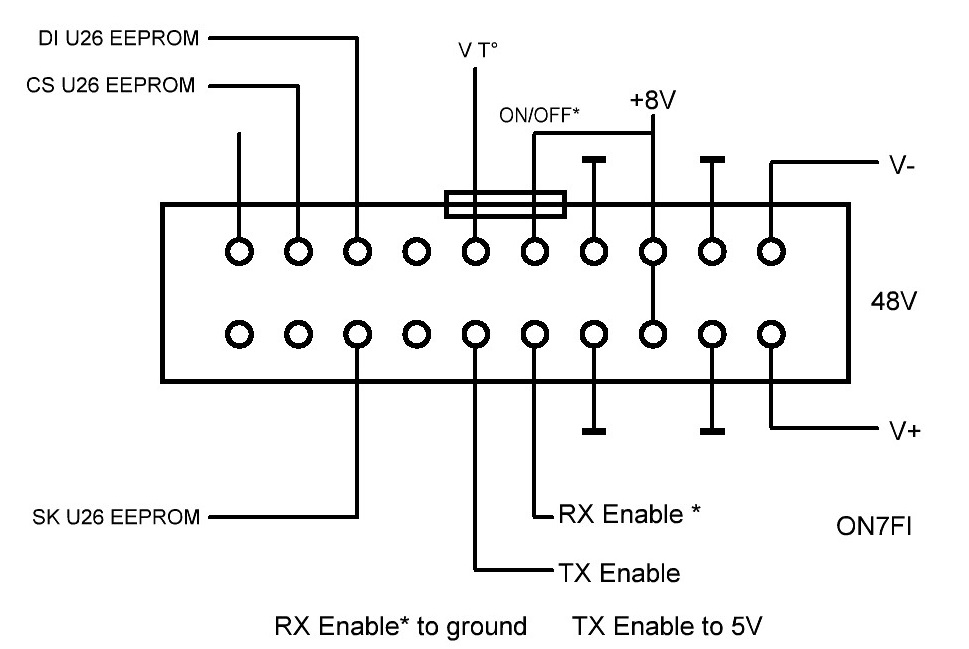
I have found a bit, but I am worried about the simple stuff: How critical is the order in which I connect the power supply. On the on6ll.be website I found the following:

Since it is used in a remote link the "base supply voltage is 48V (see the two connections at the right side of the connector). Then I see that there is a +8V connection The question is now - do I connect the 48V first, or the 8V? What I cannot easily see is where the negative bias for the GaAsFETs is generated. From the 48V converted to 7V, or from the 8V? It is not even clear if the 8V is generated on board when the 48V is connected. 

The other parts I have found sufficient information about to proceed. The LO should be somewhere around 7.5-8GHz, and the IF for the "RF/microwave" section then uses an IF of about 2.4GHz.

The T/R switching is clear enough from the description on the website, even the illustration above.

If any reader knows I would appreciate the information. I simply do not want to make a potentially destructive test, as the GaAsFETs simply will self destruct if the drain voltage is applied before the negative gate bias, as those familiar with GaAsFETs will know. If no reader knows I will have to extend the search.

Good to be back doing social activities again, there will be a few more coming up in the next months. Some of them will be outdoors, and others indoors. The next one is only a few weeks away.

2021-12-12

Testing A 2GHz Brick Oscillator, And My Microwave Testing Limitations.

Some time ago I purchased a few surplus 2GHz oscillator modules fro RF-Microwaves in Italy, designated SU-03. They are now sold out, but I finally got to start testing a few of them.

Those are synthesized modules operating on 2009MHz, with a reference crystal of 8MHz. From the description it is indicated that with a modified reference frequency the unit could be modified to operate in the 1960 - 2035MHz band.

The SU-03 requires a dual power supply of +/- 12V. For the test I used my standard variable lab PS with 12V, and a set of 3 Li Ion cells to provide the negative voltage. The negative voltage is needed, as the unit has 2 GaAsFETs that need a negative gate bias.

Power output is specified to 10dBm (10mW), so to be sure not to over-load (and destroy) the probe of my old HP432 I connected a 10dB attenuator at the SU-03 output. That was good, as the measured output turned out to be +15dBm (30mW, well above the spec of the thermistor probe). Better safe than sorry. I now have 3 units tested and in-spec for the +10dBm output. This should be quite sufficient for use with a passive (diode) mixer. 

Next step: Look at the spectrum coming out of the SU-03. Here is where I think that the limitations of the low cost Chinese spectrum analyzer, covering 35 - 4400MHz comes in. This is a device costing less than $100, so how can we expect miracles? Well, we can't.

First of all, the maximum scan bandwidth of the spec-an is 350MHz with a 500kHz "IF" bandwidth, so in order to "see" the full spectrum I need to look at 300MHz at a time, then switching to the next segment, etc. It takes some time, and it is tedious, but it can be done. 

Second limitation I see is, as I suspect, the local oscillator - I guess an ADF4351 (or a clone) - has a square wave output, so subharmonics of the original input frequency show up on the display (1GHz, 666MHz, 500MHz) quite strongly. Well, knowing the limitation is half of getting more reliable results. 

Between 2GHz and 4GHz I see no spurious coming out of the oscillator, at least they are about 60dB or more down from the wanted signal. Also, between 1 and 2 GHz I see no spurious signals. This indicates that the output from the oscillator is rather spurious free.

When looking at a more narrow frequency span, the limitations of the low cost spectrum analyzer really shows. The curve is no longer a curve, but has steps of about 5dB in the in the spectrum, and further it is possible to see the effect of the direct conversion design in the analyzer, in that the center null is somewhat visible. 

When looking at a moderate bandwidth,  some asymmetric sideband noise is visible. I can not se if this comes from the oscillator block or the local oscillator in the spectrum analyzer, but I suspect it comes from the low cost local oscillator in the analyzer.

Clearly, the low cost solution, while not useless, is not very efficient, but for now it will have to do, as I do not have a (more expensive) analyzer covering up to 2GHz or above. What I do have is a rather old (analog) model covering up to 1.5GHz. With that I can test for spurious output(s) below 1.5GHz, that's all.

Next test of the oscillator will be a frequency test. While I do have a frequency counter covering up to 2.4GHz it is not locked to a frequency standard, neither does it have an input for doing so. So high precision frequency measurements are not possible.

The frequency counter that does have such an input just covers up to 1.3GHz. What will be necessary to use my GPS controlled 10MHz source is a divide-by-10 (counter), because this particular counter requires a 1MHz external reference frequency. Some soldering work needed.

There is, however, the possibility of adding a pre-scaler to it so all is not lost. It looks like I should get the soldering iron going again, so I can get a divide-by-4 pre-scaler up and running, with that one I should be able to measure frequencies up to 3.5GHz (with the use of an added calculator) with good precision. .More soldering work. Also, this would be my first (fully) microwave construction, not just using modules or adding modulators or doing small modifications. Now it gets interesting (hopefully not in the Chinese sense of the word ;) )

What is this (modified) oscillator brick useful for? Let me see, with modifications:

- 1968MHz is within the range of operation of the VCO, so a local oscillator for a 432 < - > 2400MHz transverter (or QO100 up converter) is possible

- possibly a base oscillator for a 10GHz transverter (followed by a x5 frequency multiplier, e.g. 1987.2 x5 -> 9936MHz - LO for a 10368/432MHz conversion)

- a precise 2000MHz oscillator for down conversion of 2400MHz to frequencies that a better spectrum analyzer or frequency counter. Possibly with a divider to 1GHz and/or a frequency multiplier for higher frequencies. We shall see. what I do

Small update: 

I tested the oscillator with the old spectrum analyzer (up to 1500MHz) No subharmonic signals could be seen. The oscillator is free of spurious signals from 0 - 1.5GHz on this one. Nothing could be seen from 1-2GHz and 2-4GHz. My conclusion is that this oscillator module is very clean, at least with regard to spurious signals. I cannot measure phase noise, but I can probably get that done at a ham radio friend with better instruments. 

This looks like an excellent candidate for 2.4 and 10GHz transverters with 432MHz IF. It is fair to say that a ham radio friend recommended this at a small ham meeting, so I mostly expected this.

The interesting part comes when I try a modification for an external reference frequency signal, how much it depends on the purity of the reference signal.

More on that later.

2021-11-26

More 6GHz Attenuators Tested on 10GHz.

 More attenuator testing of nominal 6GHz attenuators measured on 10GHz with the up-converter and the HP432 power meter :

- 10dB attenuators: 2 of them very close to the 10dB mark, the 3rd 9.5dB

- 20dB attenuators: All 3 within 0.5dB of the 20dB mark

- 30dB attenuators: All within 1.5dB of the 30dB mark

All this is good enough for my amateur radio lab. Part of the purpose is avoiding overdrive and/or destruction of input devices in sensitive microwave amplifiers, as well as getting estimated gain figures.

Not bad for relatively low cost attenuators, tested out-of-spec. Now some rough gain testing of amplifiers can be done. Those 6GHz attenuators are now all in the box with 10GHz test equipment.


2021-11-25

Rough Calibration of Attenuators When Used on 10GHz.


A bit of activity in the lab today:

While I have two SMA attenuators capable of working at 10W with 10dB nominal on 10GHz, I wanted to test some lower cost attenuators specified up to 6GHz. How to test that without a true, calibrated 10GHz signal generator. Some thinking was needed. Here is what I did:

Using my calibrated (well enough for me) RF generator on 70MHz entering the signal into the up-converter described a few days ago, except omitting the output (2-stage) amplifier, just using the DRO/Mixer and the first (buffer) stage module.

This got me an output on 10GHz close to the output on 70MHz, e.g. 0dBm on 70MHz -> 0dBm +/- 1dB on 10GHz. It looks like the buffer on 10GHz essentially compensated for the loss in the (passive) mixer. OK, now I have a reference signal, showing -1.5dBm on the HP432 power meter.

Here are the values measured with the HP432:

10W/10GHz/10dB:-10.5dBm   ->9dB

2W/6GHz/10dB:    -11dBm      ->9.5dB

2W/6GHz/6dB:      - 7.5dBm    ->6dB

Non-brand

6Ghz/6dB:             - 9.5dBm    ->8dB

Return loss has not been tested, so the impedances are not well known, but given  the values I got from the brand attenuators I used, those are probably close enough for my purposes.

So now I have a good set of SMA attenuators capable of handling up to 10W, and with sufficient attenuation to avoid destroying the thermistor mount of my HP432 power meter.

Before anyone aks: Yes, I did terminate the input and output of the 200mW output stage, to avoid those stages oscillating. They might be unconditionally stable, but I do not know. With components/modules like this, better safe than sorry.

All this took some time because I removed +12V DC power from the unit every time I changed attenuators etc.

I do have 2 more attenuators capable of operating on 10GHz, those have N-connectors. They will be tested together later, as one of them is mounted in my 2.4GHz up-link transmitter system. Now, at least I know that I can safely measure power with sufficient accuracy on 10GHz.

Why do all this? Today I received a 2W amplifier from another seller in Italy, and I do want to test that one.


2021-09-21

Spectrum Analyzer Extender Using the HB100 Module as Down Converter.

Tonight I made a test of using the HB100 module as a down converter, so I should be able to "see" 10GHz band signals on my (low-cost) Tiny SA spectrum analyzer.

I have a few of the modules, so here goes:

With a previous test I had used a LNB with a more expensive spectrum analyzer I had access to. I tuned some HB100 modules to different frequencies, so I had some simple signal sources on frequencies from 10300 up to 10500MHz in 25MHz steps. I also made one for 10368MHz (narrow band) and for 10489MHz (QO100 segment).

Today I wanted to test how the HB100 module did as a simple dowm converter. Because it has been used with (broadcast) FM band receivers I am aware that it can be used as a general down converter, and sure enough, using a 10450MHz HB100 and a 10375MHz module, connecting the spectrum analyzer to the IF output of the module produced a 75MHz IF output. It does work as I expected.

However, I do not know the RF or IF) bandwidth of the module, so I have not checked that.

The base bandwidth of the Tiny SA is 350MHz, so I tested with a 10300 module and a 10600 module, and got a nice 300MHz signal. Using the modules is a bit tricky because the apparent output varies a lot when tuning.

Using a 10600MHz module should make "seeing" 10300 - 10900MHz with a small gap around 10600 (zero IF). Not too bad for a $5 module. For the putpose I also made a 10500MHz module (10200 - 10800MHz coverage) a 10300MHz module can be added for coverage all the way down to the 10000MHz band edge (10000 - 10600MHz)

I am well aware that I do not have any image rejection, but as long as I can calculate expected frequencies I should be able to estimate the spectrum of an oscillator or a transmitter.

The Tiny SA has a base bandwidth of 350MHz (LOW input), but also has an extended coverage up to 960MHz, so it should be possible to see more than 1800MHz with a single module. The question is how much IF bandwidth the module can provide. 

SM6WHY estimates on his blog that the IF bandwidth of the HB100 might be up to 2GHz. I have my doubts, but if that is the case I might try using my Chinese 35 - 4400MHz (primitive) spectrum analyzer which uses direct conversion to sweep the band. If I recall correctly, only 350MHz can be displayed at a time, but the 10500MHz version then might be able to cover 8500 - 12500MHz with a small gap around 10500.

Even if this is far from calibrated, it is much better than not being able to see anything.

For the initial test I just used the modules lying on the desk, with the antennas there. I do think that removing/disconnecting the antenna(s) and adding connectors, and put the module in a stable casing will improve the set-up considerably, both with respect to stability and reliability.

What do you think? a spectrum analyzer extender to the 10GHz band for about $5? Not bad. 

2021-09-17

Mini-Lab Downstairs.

While I do have a mostly complete lab upstairs, it will be nice to do some home construction at the operating position downstairs, and have at least some test equipment there. This mostly for simple constructions and kit building.

Here is an overview of what I have for work downstairs, with a few ideas for improvements.

- Soldering iron and antistatic mats.

- 2 Multimeters (DMM).

- single channel portable oscilloscope (100MHz?, more like 30MHz, but OK)

- LCR-multimeter (not for very low L and C values, but a start, a better one is upstairs)

- Nano VNA (900MHz Fundamental wave generator up to 300MHz)

- Nano VNA (SAA2) (3Ghz)

- (Both Nano VNAs need to be tested with a simple diode multiplier for signal generation above 3GHz, e.g. 3.4, 5.7 and 10GHz)

- Tiny SA, low cost spectrum analyzer up to 960MHz, base scan about 300MHz. (The bigger/better one is upstairs, anyway).

- frequency counter, up to 1.3GHz. Under warm-up-test. Looks like it needs a bit of burn-in to age the OCXO crystal a bit more. It has moved 5Hz @ 10MHz for now, and seems fairly temperature stable at normally changing room temperatures, < +/- 1Hz. If better stability is needed, a GPSDO can be adapted (10MHz out to 1MHz in as counter reference frequency).

- a GPSDO, 10MHz and a distributor/extra OCXO. More power supply needed.

- (I should set up some more power supply downstairs for testing. I have an older one (up to 1A w/fold-back at over-current/short circuit) that needs to be tested. Output voltage should be 10 - 15V. Claimed max current 2.5A, but looks like insufficient cooling for that.)

- (For more test equipment a 12V (not 13.8) supply with several Ampere output should be available. Must be linear to avoid noise/ripple on the output.) (Also usable for the microwave converters/transverters.) Some equipment does not like the 13.8V, and should have just a 12V supply voltage.

- for now, a few battery cases with 3x 18650 Li-Ion cells (9.5 - 12.5V), and a few Ni-MH rechargeable sets are available. (4.8V, 7.2V, 9.6V available, a casing for 10 cells (12V) can be made.)

- Charging for Ni-MH cells set up.

- (Charging for Li-Ion cells needs to be set up.)

- I think I will need a more advanced linear power supply for the downstairs lab. (There is one upstairs) I should go see if I can find something suitable. Something with both voltage and current limiting. A simple SMPS or DC/DC converter with those functions may be sufficient for quick experiments. I think I can find one in my pile of modules - 12V input buck/boost converter with 3 - 24 (30) V out, with digital meters and settings ;).

- A small set of components for experimentation.

If you can think of further improvements please consider leaving a comment.

I do have more test equipment upstairs, and that will come into use for more elaborate testing and building. It does need some (a lot of) tidying there, though.

2021-09-08

First HB100 Tests on 10GHz. Simple Low Cost Field Strength Meters.

 The first experiment with very simple equipment, using the low cost HB100 Doppler radar module has been completed: A simple field strength meter (FSM). The idea comes from F6HCC's website http://f6hcc.free.fr/10ghz.htm .

A non-functioning HB100 (with no output when supplied with 5V supplied) was modified according to F6HCC. Another as yet untested HB100 module was used as a source.

But the initial test was done by using a 2m/70cm hand held radio near the module's receive antenna. The "IF" output of the module uses a 10nF capacitor (non-critical, F6HCC uses 22nF) as decoupling for the RF to the meter. The meter used is a low cost digital multimeter (DMM) from the local DIY (home improvement) store. 

The reading with 10cm distance from the source (TX antenna) to the sensor (FSM RX antenna), and the reading is a modest 5mV, clearly seen when changing the distance.

Because most hams do have a DMM this provides for a low cost method of testing the functioning of a 10GHz transmitter and/or antenna. The HB100 module can still be had for less than $5, and the modification is simple and well described (with images) by F6HCC. Admittedly, the sensitivity of this meter is low, but it does work.

On the same page F6HCC also describes a more elaborate FSM for 10GHz, involving a diode inside a wave guide, and an amplifier for an analog meter.

However, for a much more sensitive FSM I would likely use a low cost (surplus) low noise block converter LNB, usually used with a satellite TV receiver dish. This has lots of gain, and you can probably salvage one from a discarded satellite dish. The signal on 10GHz is amplified and converted to a much lower frequency, usually around 250 - 750MHz, where a diode detector is much easier to make. Also a simple multimeter (analog or digital) can easily be used in this application. 
For measuring close to the lower band edge (about 10.0GHz) it may be a good idea to modify the LNB with an external DC supplied, not via the IF cable, but directly through a hole in the casing, and disconnect the DC "RF-choke" on the PCB from the IF connector.
Further, if there is a filter on the 11-12GHz side, it may be an advantage to by-pass this for greater bandwidth.
The gain in such an arrangement may be rather high - too high - but reducing gain in a system like this is easy. Just put some RF (microwave) lossy material between the LNB and the signal source...
There is, of course, the possibility of bypassing the RF (10GHZ) amplifier and the RF filter in the LNB, and connect the sensor antenna directly to the mixer via a piece of coax (semi-rigid coax will be the best choice), thereby reducing the gain.

If you do this, you might salvage some useful GaAsFETs, if you can avoid destroying them with static electricity.

2021-08-25

New "Toy": NanoVNA V2 Plus4

 The latest version of the NanoVNA just arrived.

The model is the NanoVNA V2Plus4. I features a 4 inch screen and it is supported by the NanoVNA-Saver program freely available.

This is a considerably improved version, capable of running up to 4.4GHz and displaying 400 test points on the built-in screen. The dynamic range is improved, too, with up to 80dB range up to 3GHz, when using 5x averaging, otherwise 70dB. Below 1GHz, and with 20x averaging all the way up to 90dB.

This makes this VNA very interesting as a stand-alone unit.

As with all the previous versions, this version can be used as a simple RF signal source, up to 4.4GHz.

There is always a catch. It appears that the people behind this design are working on a new version (v3) capable of measuring up to 6GHz. Not (yet) available, and probably more expensive, but probably worth it for me if I continue to want to build microwave equipment.

Now the question is, when will there be a version capable of measuring the 10GHz amateur band? It will not surprise me if we see a v4 with that capability in the not too far future (5 years?).


2021-08-23

Flea Market in Frederikssund and Test equipment.

 This was the first larger arrangement I have attended since the corona closed down everything social, sort of.

I am still glad that this was an outdoor event.

It was good to meet some old and new friends. I had been talking to a local on the QO100 satellite, and finally we got to meet in person.

I did not bring too much back home, as the house is quite full of stuff. What I did get, was some good quality attenuators (10W/10GHz/10dB) and an older frequency counter capable of 1300MHz.

The counter has been under test a while, testing the reading of my 10MHz GPSDO. After close to 2 days (warming up the reference oscillator) it looks like the reference frequency oscillator is 2Hz off on 10MHz. Not too bad for HF/VHF, but insufficient for UHF and microwaves. The variation with temperature (there is a simple OCXO inside) seems to be less than 1Hz after warm-up, so stability is quite good.

Reference frequency alignment is in my future. 

The counter does have a 1MHz reference frequency input, so it will also be possible to lock the reference to a GPSDO for the best possible stability and accuracy.

2021-07-26

Test Equipment, Part 1a: Idea Box: Using Nano VNA as a Portable RF Signal Generator.

 Not everyone can afford expensive RF signal generators, or even several less expensive ones, so here are some thoughts on how to make simple signal generation with a Nano VNA, probably the least expensive piece of test equipment with excellent functionality for the amateur who wants to build some equipment, or even just as an antenna analyzer.

In my case I want to be able to check receivers up to the 10GHz band, maybe higher, so what to do with a simple Nano VNA?

I have been looking a bit around to see what others have done in this regard, so here is my 

Up to the 70cm band.

For the 2200m to 70cm bands, even the oldest version of the Nano VNA can be used directly. Even though it does not have a calibrated output (amplitude or frequency) It will provide a (not very clean) signal, but if you know which frequency your receiver is set to, it will work fine. If the signal is too strong it is possible to use attenuators, for the HF bands and lower they can be home made, it is more difficult on higher frequencies. 

It is also possible to use the VNA as a "personal beacon" test generator, though a keying circuit (and amplifier) has to be added. What about your own low power CW transmitter? Mind you, some filtering will be necessary, as the VNA signal is not really clean, but for an experiment it will work.

Higher bands.

The simplest way to generate signals on the microwave bands will be a simple diode multiplier (comb generator).
So here we go: Add an amplifier followed by a 3 - 6dB attenuator to the signal generator output. It is likely a good idea to add a simple band pass filter as well. Then connect a diode across the output of the attenuator.
Why the attenuator, you may ask. This is in order to have a good load of the amplifier, giving a more stable output.
Next question: Which kind of diode can we use? Given what others have done, with sufficient input power into the diode, PA3FYM reports + 7dBm is sufficient to generate a 10GHz signal using a standard (dirt cheap) 1N4148 silicon diode, so that is what I would try first. Others suggest using step-recovery diodes for generating stronger harmonics, but why do that if the low cost solution works.

With a 432MHz (filtered) signal from the Nano VNA, signals should be generated on 1296, 5760 and 10368MHz, providing signals for narrow band receivers. About 437MHz will provide a signal in the QO-100 satellite downlink band on 10GHz, and should be within range of the band pass filter.
With 400MHz a 2400MHz signal can be generated.
With 425MHz a 3400MHz signal can be generated.
This covers all amateur band allocations (up to and including the 10GHz band) available to me, and should be sufficient to check receivers on all bands, if no other (better) RF signal generator is available.

Given the relative simple design of this I might try it out. I can test the 10GHz signal with a (synthesized) Satellite LNB, initially I will test without a filter on 432MHz, just to see if it is necessary. I might even try to connect the diode directly to the output of the Nano VNA Simplicity rules ;)

All this is with the cheapest version of the Nano VNA. As you may be aware, there are versions with a larger frequency range. The SAA2 (Nano VNA v.2) works up to 3GHz. More expensive, but much easier to work with, up to and including the 2400MHz amateur band. The diode multiplier should also be useful with this model.

The Tiny SA (spectrum analyzer) should be able to work as an RF signal generator, so this might be useful as well, if you have one.

One other option may be using the generated signal from a scalar network analyzer (35 - 4400MHz. I do not know if the spectral purity is sufficient for those PCBs, or if the frequency can be set to a fixed value, but I guess this has to be tested, too. First more research on the Internet. If this one works, the 3400MHz band will be included, but no HF/MF/LF. Everything is a compromise.

2021-03-28

Test Equipment part 1: RF Signal Generators.

Working with transmitters, receivers and antennas is not easy without test equipment. Sometimes a quick test can be done with your transceiver, or a receiver. More detailed testing requires more. I would like to build equipment for up to 10GHz, at least, as well as going all the way down to 136kHz. Optical communication would be nice to try, but this is outside the scope of this post.

Now, for testing a receiver (part), some kind of signal generator is needed. It is always nice to have the generators calibrated, but for amateur use less can do it.

Excluding using the transceiver, there are a few options for very simple and low cost test generators:

1) Low cost Chinese PCB modules. I found:
a) 0 - 5MHz function generator. It is using a DDS, meaning that the stability is essentially as good as a normal crystal oscillator, no calibrated output level, though, just a potentiometer.
b) 0 - 55MHz signal generator with a DDS, same limitations as above, but no level regulation at all.
c) 35 - 4400MHz generator, with same limitations as the one above.

This will create a usable signal for use up from close to DC up to 4400MHz. Using a harmonic of the 35 - 4400MHz it is quite possible to generate a signal usable for testing if a 10GHz receiver is functional at all. These modules can probably be purchased for less than $100 on Ebay. Not bad for a simple setup. I do have such a set of modules, but I decided to go up one step. Yes, somewhat more expensive, but easier to use. 

There is one more option for a low cost signal generator: The NanoVNA.
This VNA comes in 4 different frequency ranges: 50kHz - 900MHz, 50kHz - 1000MHz, 50kHz - 1500MHz and the NanoVNA version 2 (SAA 2) with 50kHz - 3000MHz. The output of those are not all too clean, but they will all provide a signal that is sufficient to test the rough function of a receiver, or as a test oscillator for a transmitter.

2) My signal generators:
a) FY6800 DDS signal generator/unction generator up to 25MHz. output not calibrated in dBm or microvolts, but it can deliver up to 25V, as far as I recall. could be used as a test exciter for a transmitter, too. This one covers the low bands very nicely, and I can use attenuators for testing receivers.
b) 500kHz - 470MHz generator. This one has a sufficiently calibrated output level, and delivers up to -73dBm, the equivalent of an S9 signal in a receiver. A bit low, but fine for testing that a receiver is not defective or completely out of alignment. I could add some amplification to increase the level, and I will do that if I find the need.
c) TPI 1002A generator. This is built by a Texas radio amateur who runs the company RF-consultant ( www.rf-consultant.com ), and covers 35 - 4400MHz with a calibrated output level from very low up to over 10dBm. The generator is controlled via a USB cable needs a computer running Windows, at least XP. I ran a quick test of the generator at 2400MHz, using a (long ago) calibrated power meter, and the levels were nicely corresponding, and therefore good enough for my use. The generator can be programmed to optimize the output for low spurious output or low (sideband) noise output. very useful for many measurements on these high bands.
d) a small box with a Chinese built ADF 5355 generator capable of generating signal up to 13600MHz, yes 13.6GHz. The unit can be used independently, but I think that it can be controlled via the USB port, too.

Why not use surplus (professional) test equipment? I have had some of this, but space (or cost for newer, smaller equipment) does not allow for this in my case. Yes I do have a bit of this kind of equipment, but no longer for (RF) signal generators.

Why did I not try to build this kind of test equipment? First, it would take me far too long, and I would need access to calibrated test equipment to get them working properly. Second, my priority is to build some (not too complex) transmitter and receiver equipment for all amateur bands from 136kHz to 10GHz, I have got the idea that I want to try to make a QSO on every amateur band available to me with home made or modified (surplus or not-designed for amateur radio) equipment. For now, I have only done this for the 3.5, 5.2 and 7MHz bands, so there is some work to do.

2020-10-25

Intermistic Repair of Low Cost Spectrum Analyzer.

 I purchased a low cost spectrum analyzer from China.

This is the LTDZ spectrum analyzer that covers a frequency range of 35 to 4400MHz, with some limitations. 

The first limitation is that the frequency coverage in a single sweep is limited to 350MHz. This does make the analyzer more cumbersome to use, but id does make it possible to "see" signals up to 4.4GHz, and that I could not do before.

The second limitation lies in the type of detection. The LTDZ uses a direct conversion approach to the frequency making the signal visible twice (no image rejection) in narrow sweeps.

The analyzer does have different "IF" bandwidth settings ranging from 5kHz to 500kHz, so it makes for a fair, but far from excellent, resolution of signals in the low microwave range. I suspect the dynamic range will be the limiting factor for this device, but a good indication of spurious signals is better than none.

The model I purchased has no tracking generator, but it it in a shielded case and it does have a built-in screen and battery, making it a good portable device. Just make sure there are no strong transmitter signals nearby, if you use it with an antenna - another repair job to do. I speak from experience, I destroyed the input mixer of an LTDZ, just by having a hand-held transceiver transmitting nearby. 

On the casing it says that you should have no more than "10dB" at the input. I have to assume this means 10dBm. In any case, the linearity of the mixer is probably not sufficient to make good measurements at this level, I suspect that the maximum input level for decent linearity is probably around -20dBm, but this will have to be tested.

When the device arrived the ON/OFF switch had been destroyed. I decided that, rather than having the hassle of sending the device back to China and wait for a repair, I would change the switch myself. OK, I do not have such a small switch at hand, so a preliminary, "emergency" repair has been done.

The existing switch has been removed, and a larger switch has been connected with two wires to the solder pads of the original switch. The external switch is attached to the outside of the casing, duct tape is such a good invention (if it was good enough for the astronaut on Apollo 13, it must be good enough for me ;) ).

I now have a working LTDZ.

One thing, however may need to be attended to. When it is running, the battery indicator seems to jump from a good battery level, sometimes to a zero battery level. It does not seem to interfere with the functionality, but it is annoying to see the battery indicator show an empty battery periodically.

The missing tracking generator is not a huge loss for two reasons:

I do have a NanoVNA v.2, working from 50kHz to 3GHz, so I can make filter and antenna measurements up to 3GHz. Also, when I get the software installed, I do have a PCB based LTDZ board with a tracking generator and a directional coupler covering 3.5 - 8.8 GHz (Would likely work nicely on 3.4GHz, too), so filter measurements are not a problem on the 3.4GHz band. With an external signal generator and a wideband power meter measurements of filters and antennas should work nicely on 5.7GHz.

I do have a signal generator covering up to 13GHz, and with another directional coupler (that I have) and a wideband power meter, measuring on the 10GHz band is possible.

So, in the not too far future a power meter capable of measuring up to the 10GHz band is in the planning. While I do have a bolometer HP-432A, this is not portable, so measuring antennas will be a bit tricky, therefore I intend to get a digital-readout (logarithmic) power meter up and running, and get it calibrated as well as possible.

Oh, yes, I have collected a few pieces of test equipment in my time, but a bit more is needed, now that I have entered a phase of my life with more time for experimentation. 

2020-06-05

Test of OCXO and Rubidium Standard. And Building a Bit.

I wanted to test some 10MHz OCXOs so I needed some stable reference. I have a surplus rubidium 10MHz standard, and tried it for the first time.
In the first instance I want to get my very old, but otherwise frequency counter up and running again. The counter did have a reference oscillator locked to the old transmitter frequency of the national long wave station of 245kHz, which moved to 243kHz in order to comply with the new frequency grid. The reference frequency of the counter is 1MHz, generated by a crystal oscillator, which cannot now be locked to the standard. A new reference oscillator is therefore needed. The counter does have an input for an external 1MHz reference.
When I last tested the counter, the frequency adjustment range of the oscillator had deteriorated, so it could not be adjusted to the correct frequency, so I decided  to generate an external frequency.

The intention is to use a oven controlled crystal oscillator (OCXO) which can then be calibrated occasionally with the Rubidium standard, or maybe later, with a GPSDO reference.

In order to test the OCXO an even better reference is needed. so I found my surplus rubidium  (Rb)standard and tested it for the first time. I do not know its exact frequency (well 10MHz), but I could see the classic frequency sweep for some minutes, and after some cycles it locked into place.
So now I have a stable 10MHz reference, which should probably be calibrated, but I will use it as it is for now.

The first OCXO needs a 5V supply, and the Rb but at the test bench I had only one variable supply and a fixed 13.8V supply. I then built a quick 5 and 9V supply, using two DC/DC buck converters. All went into a small plastic box, normally used for interconnections in electric installations. The voltage into the converters can be from 12 - 30V, so I connected it to the 13.8V supply, the variable lab Power supply was then available to provide power for the Rb standard-

In order to compare the frequency I connected the two oscillators to my 2 channel scope, triggered by the Rb standard (Ch1) and connected the OCXO to Ch2, after letting them warm up for an hour or two.
Of course, the signal from the OCXO will then move across the screen, because its frequency is different from the Rb standard. The trick is then to change the control voltage of the OCXO until the signal moves as slowly as possible across the screen.
I managed to adjust it to move across one period, taking 3min:40sec (220sec). This corresponds to a frequency difference of less than 5mHz (yes, *milli*Hertz), but it was still drifting a bit.
However, this is quite acceptable, because the OCXO was just lying on the test bench, and not even insulated. A well insulated OCXO should be sufficiently stable for my amateur use (when placed indoors), even up to 10GHz equipment.

What next? I think I should build one of the OCXOs into a box (w/insulation), then add some buffering for the 10MHz signal, so a few output signals can be generated, as well as a "converter" for generating a 25MHx signal for control of an LNB, and finally a divider for generating a 1MHz signal.

The intention for the 25MHz signal is using a divide-by-two (5MHz), then extract the 5th harmonic, and voilá ... 25MHz. A square-wave conversion circuit followed by a good filter is probably a good idea.

Oh!, and testing the other OCXOs need to be done, too

All in all this was a few productive days, getting more test equipment up and running. Always enough projects to do here.

2020-05-16

Build of a Small PCB Based Oscilloscope - and Another Oops.

A little while ago I purchased a kit for a small, very simple oscilloscope.
This is the JYE Tech DSO138, a kit with SMD components soldered, so only through-hole components need to be mounted.
The scope is a single channel device with a bandwidth of 200kHz, using a sample rate of 1Ms/s, and has a small, but readable 2.4" screen, if I recall correctly.
The kit went together all right, even if soldering was tricky, even with a quite hot soldering iron. The tip had trouble heating up the PCB pads, probably because they had a very narrow edge around the through-holes.
Otherwise, when I finally found the assembly instructions for the correct version of the board, the check/test went well, and after adjustments the screen shows a relative good square wave, using the built-in test generator.
This test was done with a USB cable connecting a 5V power supply to the scope.

Now came the test with the "normal" power (only) connector on the analog board (with all the switches etc). I found a battery and a red/black wire set mounted on the connector, got it connected, and - <snif> <snif> - something gets hot, and nothing on the screen.
A check revealed that the connector had reverse polarity .... Oops.

A correctly connected cable was found, and phew! The screen showed something. But not all was good.
I checked the voltages on the board, and the -5V voltage was essentially absent - a few 100s mV. Not good. I disconnected the output of the ICL7660 DC/DC converter IC, still no negative voltage output.
The 7660 has definitely gone to the eternal IC fields. The quad OP-amp could also be defective, so I have ordered spares of both.
The arrival of the spare parts is expected in a few weeks, so the project is now on hold. Not a huge problem, it is not a critical item that I need right now, and I have more than enough other projects to get to.

So, what can we learn from this? Oh, yes, when building kits and/or connecting power  to kits or modules, check, then double check the polarity of the power supply leads, and the polarity on the PCBs.
A pity that there is no standard for this, but what can we expect from stuff coming from different parts of the world?

2020-03-05

Analog Vs Digital Multimeters.

When should one use analog, and when digital meters for (mainly) voltage and current measurements?

To me there is an easy answer.
If I am adjusting something for maximum or minimum values, the analog meter wins every single time. It is much easier to see when the max/min values are reached with a "moving needle" meter.
Will I go without the digital multimeter? No way. It makes for an easy measurement of more or less static values.

So yes, I have a set of digital multimeters with Volt/Ampere/Ohm measurement, and one with capacitance measurement.
A cheap Chinese PCB module serves as L-C meter, down to most of the values I need to measure, about 1pF and some nH (I need to test the latter).

I just took out 2 museum pieces: Unigor multimeters. Good quality analog meters for V/A/Ohm, all the way into the Mohm range. The only thing is the battery needed for resistance measurement. Most modern meters use AA or AAA cells, or a 9V battery. Those 2 meters use 1.5V D-size cells. Now I need to find out if I can still get those. If not, I will have to find/make an adapter.
OK, the resistance measurement on the analog meter is not that important, but why not restore the full function of those museum pieces?

Apart from the multimeters I still have 3 excellent analog meters: An AC (milli)volt meter with high impedance input, a DC (milli)volt meter, and a Bolometer with a thermistor probe for up to 10GHz, one that needs care, not exceeding 10mW input to the probe, in order to keep the meter functional. More than 10mW, even for a short while, and the probe burns out.
A set of older (second hand) attenuators (for use with the Bolometer (power meter)) will have to be tested, but I have some, at least, new ones that should be good for low power measurements, up to 1/2 - 1W.

With access to the test equipment I should now be able to do a bit of home construction activities again, be it kit building or fully home made circuits.

Update:
I found an adapter for mounting AA batteries in the Unigor meters.
One of the Unigor multi-meters is now in working order. Ranges:
10uA - 1A
100mV - 1kV (DC and AC (the AC is probably not precise in the lower ranges))
Resistance measurement not very precise, but for that the digital multimeter will probably work better.
The other meter probably requires disassembly. If I get it back in order, I can measure up to 10A with that one. This is for later.